Monday, December 1, 2014

The Price of Car Food

Gas prices are going down and everybody is happy! The national average price of gas is currently below $3, and it's continuing to drop. Some places, such as Wyoming and Montana, have been falling more slowly. However, the prices are all falling. Time Magazine has said that a new national report predicts the average gas price next year (2015) will be about $2.94.

How do these prices affect our country and each of us individually? Great question. Most people see low gas prices and go, "Yeah! Whoo-hoo! Party time!" And of course, low gas prices are good, up to a certain point. People will buy more gas because it costs less, and there will be more money flowing in the economy- until there isn't. Eventually, if the gas prices get low enough, the gas companies will start losing money. Then they'll have to fire people, and our unemployment rates will go up. Yay. 


www.msnbc.com/rachel-maddow-show/why-the-sudden-drop-gas-prices-matters

Wednesday, October 29, 2014

Water for Rural Indian Schoolchildren

Many children in India live in rural areas. Those that do generally do not have any sanitary facilities. That's a fancy way of saying they don't have any toilets. Surprisingly, the is a reason that many girls drop out of public schools. While the boys can manage with nature, the girls and their families are uncomfortable with that idea, understandably. Besides simply providing clean drinking water and sanitary facilities, this project also helps keep girls on school.


I think this project is a great idea. Clean water is a human necessity, so this is great. Besides that, it makes school for girls more attainable. In poorer countries like India, girls often are not allowed to go to school. We should do what we can to help. When we are in a position to help, we always should.

Girls this new project will help.


Tuesday, October 7, 2014

Ebola in America

Ebola is a very dangerous disease for which there is no vaccine that originated in Central Africa. It's carried by bats to people. Highly contagious, the disease can be passed through simply touching something an infected person has touched. Symptoms appear roughly ten days after coming in contact with a sick person. There have been several outbreaks since the disease first appeared in 1976. Currently, there is an epidemic of it that is the worst outbreak to date. Since the disease's outbreak this summer, there has been one confirmed case of ebola in the United States.
Jaguars
As a country, we should be very concerned about this. I think we need to do two things. First, get tough. I don't care if people from Liberia want to get into the country. Too bad, so sad. If we aren't straight out banning all flights from central Africa into the U. S., then we need to at least quarantine them for two weeks (just to be safe). Also, I think we should shut Dallas down. It's bad enough that ebola is in America at all. We don't need to let it spread anywhere else. Being under quarantine for a month wouldn't be that bad, honestly. If we aren't tough for a few months, that's all it would take for the disease to spread. Second, we need to work on a cure. Obviously, it's only going to get worse if we can't cure it. Preventing it is the easiest way to deal with it.

Sunday, September 14, 2014

Water in Africa

There are nearly a billion people worldwide who lack access to clean water. That's about a seventh of the world's population. Every 20 seconds, a child dies from a water-related disease. 3.6 million people in total die a year from diseases carried in water. The fact is, water and access to clean water are the difference between living and dying, surviving and thriving, for millions of people, especially in Africa. African water contains several dangerous things, like human waste and bacteria, that these people are ingesting.
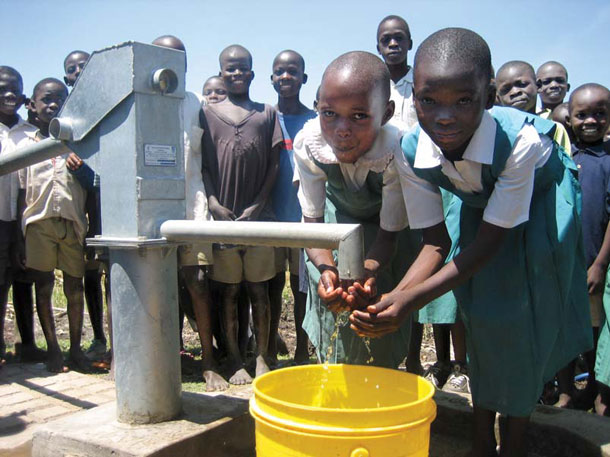

A working pump can make all the difference, as it does for these schoolgirls in Kisumu, Kenya. The pump was installed by White’s original charity, WaterPartners. | Photograph courtesy of Water.org


Obviously, lack of water is a problem in Africa. So, what are we going to do about it? There are several possible solutions. One is installing wells and rain catchment systems in the village for relatively small amounts of money. Another is using a solar panel pump, or more effectively managing the clean water.


In my opinion, we need to do a few things to solve unsanitary water in Africa. First, we need to recognize that this is a serious problem. Second, the water needs to be managed better. Third, the African governments have got to be able to get along for this to work. Finally, there has to be a way to pay for everything. Really, honestly, our government at this point simply can't afford to pay for everything. Of course, it's good to help as much as we are able, but the way things stand now, that wouldn't be nearly enough. Our best solution to the money problem is to find ways to lower the cost so that the African governments can afford to pay for everything. Heartless as it may sound, they really should pay for it. It's their responsibility.\


Sources: How To Beat Africa's Water CrisisWater Aid, Can Matt Damon Bring Clean Water to Africa?

Sunday, September 7, 2014

Should Human Hearts Be Auctioned Off?

Think of everything in America that you can get at no cost. Air? Freedom? How about human hearts?

It's estimated that up to 50,000 people around the world are on the waiting list for heart transplants, yet only 5,000 surgeries are performed per year. The fact is, there aren't enough hearts for everyone. Some people will die because they don't get hearts. How do we choose who will get a heart? Should money be an issue? Ultimately, should the highest bidder get the heart?

This is something that's personal for me. My little cousin was born 10 months ago with a serious condition that required a heart transplant. She is my aunt and uncle's sixth child, so they have a lot of expenses. Their oldest just graduated this year. They have to travel 500 miles to get to the hospital with the baby's primary doctors. Along with all of her medical expenses, there are five other children, travel expenses, along with a college student. I don't know if Aavah would've gotten a heart if it'd simply been auctioned off. And I don't particularly think that would be a nice feeling as a parent, knowing they're selling parts of my dead baby to the highest bidder. I can understand compensation, making the transplantee or the parents pay a fee. But I don't think it's a good idea to sell parts of humans; we wouldn't sell live, whole ones.